
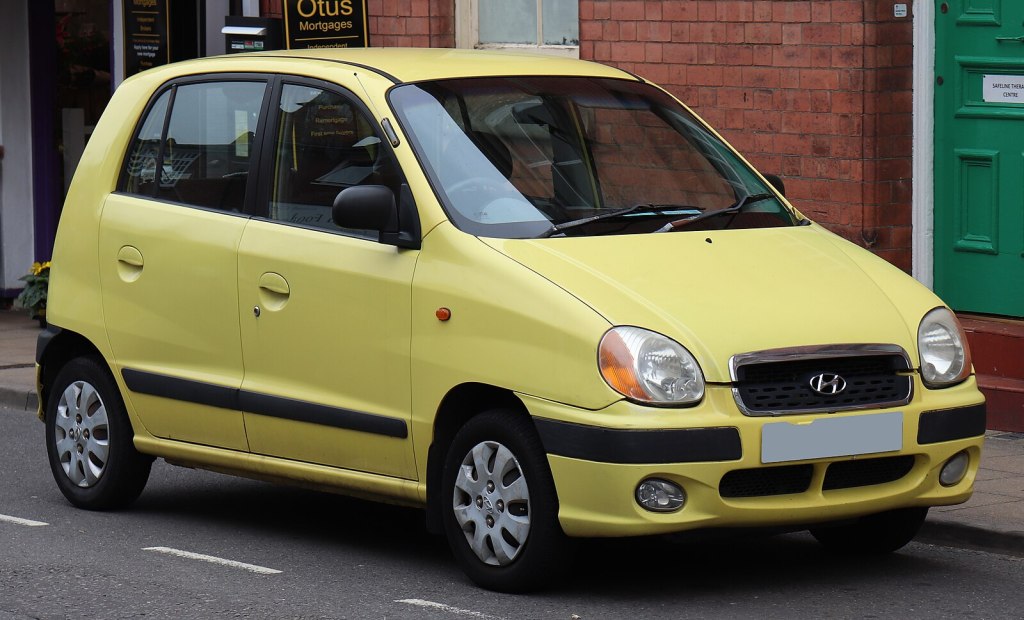
Suggesting that the manufactures of the Atoz will be the saving grace for the future of automotive design is a worrying statement, and one which suggests a dystopian world where people would rather pluck out and eat their own eyeballs as to avoid looking at their own cars. However, Hyundai have actually grown beyond the Atoz and are now thriving in the hydrogen and electric vehicle market.
Some car manufacturers have seemingly hopped onto this new trend of butchering the design of their classic cars, defending the decision to do so through claiming this move to be “innovation”. Which, if you ask me, can be blatantly seen within the new Ford Capri, or more astoundingly the new Jaguar Type 00 concept car, but Hyundai have seemingly gone against the tide, making potentially one of the most exciting cars in the history of… well forever.
The N Vision 74 is Hyundai’s new hydrogen electric performance car, supposedly styled after their 1974 Pony Coupe, where thankfully they didn’t design it after their Atoz. The N Vision 74 however has stayed faithful to the source material, while upgrading the design to comfortably bring it into the 21st century. But there are two distinct things which the N Vision 74’s design nails, and what makes me believe the future of automotive vehicle design is in safe hands with Hyundai.
Hyundai, within the entirety of their electric vehicle catalogue, has managed to maintain the essence of internal combustion within the design of their electric cars. They’ve managed to visually maintain the lovable faces most combustion cars have possess, and in turn their soul, a feature which most electric cars are lacking.
With electric vehicles not requiring the same components or airflow as internal combustion vehicles, manufacturers have acquired a new found freedom when designing their vehicles, and one which has personally left me unsatisfied. However, for example, the Ioniq 5 N, to me, actually looks like a car with personality, instead of an angular square block of metal and plastic which other electric vehicle manufacturers have gravitated towards.
But more importantly, The N Vision 74 looks as if it’s from the future. The N Vision 74 not only looks like the 1974 Pony Coupe its designed after, but it also bears a striking resemblance to the one and only DeLorean, a car seemingly so futuristic it’s now the first thing you think about when anyone mentions time travel. And this is what electric cars should strive for. If we have more of a creative freedom with how we can design vehicles, I would prefer to live in a world where driving through your local village looks like a scene out of back to the Future with retro-futuristic classic looking cars, rather than a geometric hellscape of blank moving blocks.
And this is what I believe electric car manufactures should be aiming for, retro-futurism whilst also maintaining design elements found in internal combustion vehicles. I reckon this would not only boost sales with people hesitant to transition to electric vehicles due to their current soul-less, blocky design, it would also boost sales with people who have dreamed of owning a DeLorean or similar futuristic styled cars.
But as vehicle production is being forced towards electric and hydrogen power, I firmly believe that the future design of electric and hydrogen vehicles is in safe hands.
“2002 Hyundai Atoz 1.0 Front” by Vauxford is licensed under CC BY-SA 4.0.
Tags
dan, boland, dan boland, atoz, automotive, back to the future, capri, cars, concept, design, electric, electric-vehicles, ford, future, hyundai, ioniq, jaguar, n, n vision 74, opinions, style, technology, type 00

 Group-B
Leave a comment